A Survival Guide to the Jungle of LED Strips
LED strips can be used to create a wide variety of lighting effects: long, continuous lines of light for general and mood lighting, subtle lighting for furniture, as well as striking colors and moving effects. However, there are differences in the characteristics of the strips that affect both the installation and the final result. The operating voltage, LED technology, and control method are selected based on the project’s needs, and the right profile and diffuser complete the look.
In this article, we’ll approach the selection of LED strips from the perspective of practical needs: how long you want the light strip to be, what the light should look like, how you want to control it, and where you plan to install it. We’ll go over how these factors influence the choice of strip and installation method so that you can find the right solution for your project.
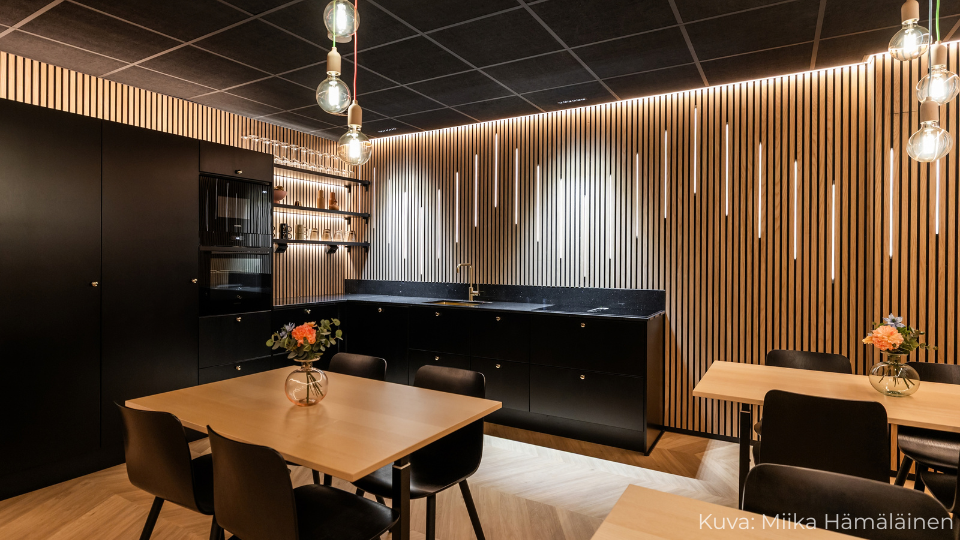
LED strip modules add a touch of vibrancy to the slatted panel and highlight the shelving unit on the wall.
How long of a light bar are you hoping for?
For standard home or office lighting, a 24-volt LED strip is a good starting point. Whether the entire length can be powered from a single end or whether multiple power supply points are needed depends on the strip’s power rating and design. When the goal is to create a continuous line of light spanning tens of meters with as few power supply points as possible, a higher-voltage 48-volt strip designed for long runs can simplify the installation.
The total length of a light strip and the maximum length allowed with a single power source are two different things. Even a long light strip can be constructed from shorter sections, each powered separately. Therefore, when planning, it’s a good idea to consider not only the length but also where the power will come from.
Why does the operating voltage affect the feed length?
24 V is a common operating voltage for fixture lighting, indirect lighting, and other lighting circuits in buildings. Alongside this, 12 V and 48 V strips are also used. The key to understanding the differences lies in the relationship between voltage and electric current: at the same power, a higher voltage means a lower current.
For example, a 120-watt LED strip assembly requires:
12 volts, 10 amps
5 amps at 24 volts
2.5 amps at 48 volts.
The power is the same in all cases, but the current carried by the cables and the copper conductors in the tape is different.
Why are higher voltage and lower current beneficial?
Electricity flows from the power source along the power cables to the tape and then along the tape’s own copper conductors. The conductors have resistance, which causes the voltage to drop along the way. This is called a voltage drop.
Long distances, high current, and thin wires increase voltage drop. If the voltage at the far end of the strip drops too much, the light may dim and the colors of a multicolor strip may become uneven.
A lower current reduces voltage drop in the same conductors. Therefore, a higher operating voltage helps to achieve longer sections with a single power supply.
When should you choose a 12-volt LED strip?
A 12-volt ribbon is often selected based on the existing electrical system, such as in a vehicle equipped with a 12-volt system. In such cases, the ribbon and other components must also be able to handle voltage fluctuations in the system.
12 V strips can also be used for building lighting when paired with a suitable power supply. However, in long or high-power installations, their higher current requires more careful planning of the wiring and power supply points.
When does 48 V offer an advantage?
The benefits of the 48 V strip are particularly evident in long lighting runs, where adding additional power supply points would be cumbersome. A strip designed for long runs can reduce the amount of cabling and simplify installation in locations such as hallways, ceiling recesses, and long indirect lighting setups.
For example a Mojova Ultra Long 48 V, 8 W/m LED strip can be powered from one end for lengths of up to 40 meters.
The maximum feed length always depends on the tape's power rating and construction. Therefore, the operating voltage alone does not indicate the maximum length; instead, it must be verified in the product specifications for the selected tape.
The power supply’s output voltage must match the strip’s operating voltage, and the controller must also be compatible with it. The power supply and controller are rated based on the total power of the strip connected to them. For the aforementioned Ultra Long LED strip from KVS, there is also a sufficiently powerful 321W power supply.
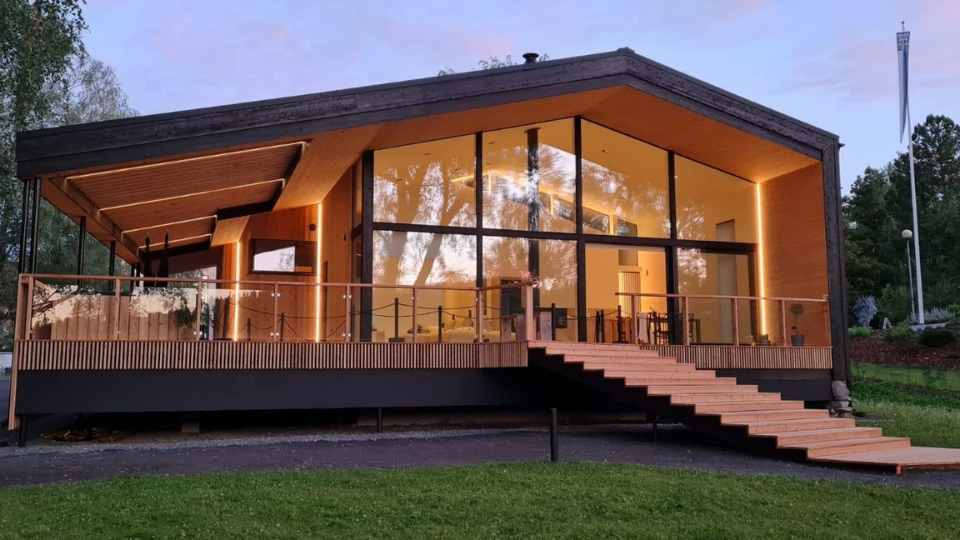
Will the LED strip be installed indoors, outdoors, or in a bathroom?
In dry indoor environments, an IP20 strip is usually the right choice. When the strip is exposed to water or dust, a more heavily protected design is needed. In bathrooms and outdoors, the choice depends particularly on where the strip is installed and the conditions to which it is exposed.
What does the IP rating indicate?
The IP rating indicates a product's protection against foreign objects, dust, and water. The first digit indicates protection against solid objects, and the second digit indicates protection against water. The rating does not indicate, for example, resistance to heat, freezing temperatures, or UV radiation.
IP20 – for dry indoor environments. The strip is not protected against water. It is suitable, for example, for indirect lighting in living rooms and for illuminating dry furniture and shelves.
IP45 – protection against water jets. The design protects against foreign objects larger than one millimeter and water jets, but it is not dust-tight. The tape may be suitable for use in damp environments or outdoors, provided the manufacturer has intended it for such use and the requirements of the installation site are met.
IP65 – dust-tight and protected against water jets. This is a suitable protection rating for many installations exposed to water and dust. However, IP65-rated cable is not intended for submersion in water.
IP67 – dust-tight and protected against the effects of temporary submersion. This rating does not imply continuous underwater use. Nor does it alone guarantee resistance to water jets; therefore, check the product instructions for intended use.
In the bathroom, the location is key
The level of protection required in a bathroom depends on the tape’s location relative to the shower or bathtub, as well as whether the tape is likely to come into contact with water. Therefore, no single IP rating can be recommended for all bathroom installations. The operating voltage, the location of the power source, and the electrical installation requirements for the space are also taken into account as part of the overall assessment.
Outdoors, on the other hand, in addition to water resistance, the cable must be suitable for the temperatures and exposure to sunlight at the installation site. A high IP rating alone does not make every cable suitable for outdoor use.
Protection must also be maintained during installation: cut points, joints, and cable glands must be sealed according to the manufacturer’s instructions. The profile and diffuser do not, by themselves, make the IP20 strip water-resistant.
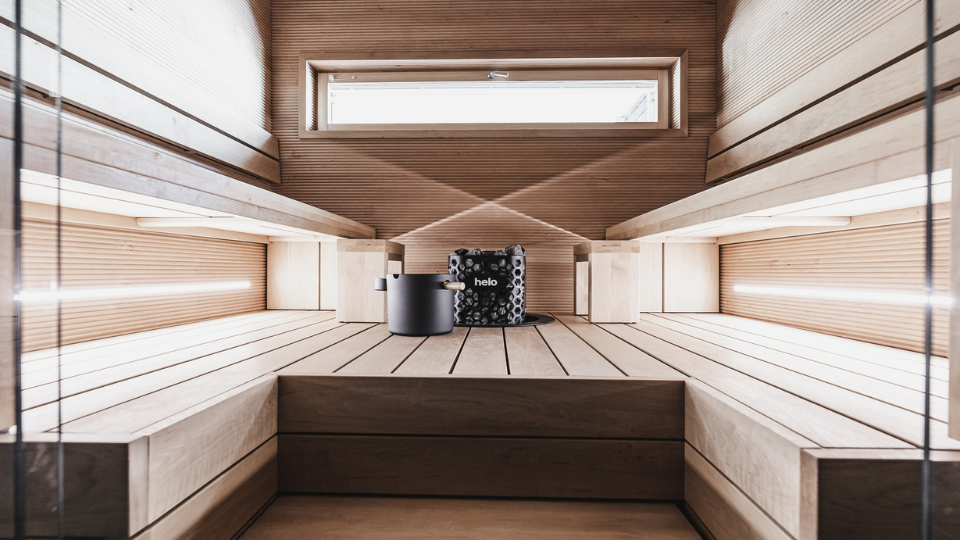
A standard IP65- or IP67-rated strip can be installed under the sauna benches, but any strip installed in the sauna’s ceiling structure must be able to withstand a temperature of +125 °C.
Heat resistance is also required in a sauna
In a sauna, moisture protection is just one factor to consider. The temperature near the ceiling is significantly higher than under the benches, so standard LED strips cannot be installed on the sauna ceiling based solely on their IP rating.
The Mojova Bastu sauna LED strip is designed to withstand operating temperatures of up to +125 °C, so it can also be installed on the sauna ceiling in accordance with the manufacturer’s installation instructions.
The Bastu cable comes with plugs and sealant to seal the cut ends in accordance with the IP65 rating. The cables, fasteners, and other components used in the installation must also be suitable for the temperature at the installation site. The power supply and controller must be installed in accordance with their respective operating temperature limits.
Does a uniform, dot-free line of light appeal to the eye?
The light from an LED strip can appear as separate points of light or as a continuous line of light. This depends on the LED technology used in the strip and the type of profile into which it is installed. SMD and COB are two different ways of constructing the light source in an LED strip.
SMD – individual LEDs on the surface of the strip
In an SMD strip, the LEDs are separate components mounted on the strip's circuit board at specific intervals. When viewed directly, the individual LEDs appear as distinct points of light.
An even line of light can also be achieved with an SMD strip. When the strip is placed deep enough within the aluminum profile, the light from the LEDs has time to spread and blend before reaching the diffuser—that is, the light-scattering cover of the profile. The distance between the LEDs also plays a role: the light points from densely spaced LEDs are generally easier to diffuse than those from sparsely spaced LEDs.
SMD is also a good option for indirect lighting, where the strip remains hidden and the light is reflected off a wall or ceiling, for example. In this case, it is important that the illuminated surface appears uniform and does not have any distinct points of light.
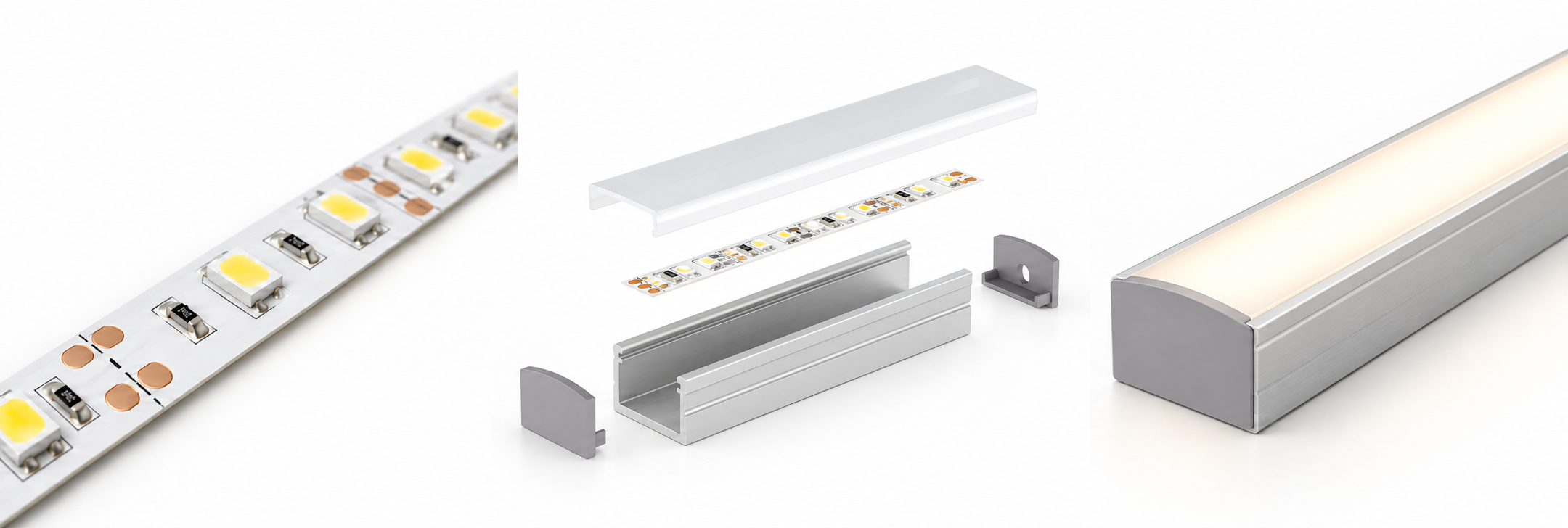
Illustration of the SMD structure and its installation on an aluminum profile.
COB – a uniform light-emitting surface already integrated into the strip
In a COB strip, small LED chips are densely packed directly onto the circuit board. In a standard white-light COB strip, they are covered by a uniform layer of phosphor, making the strip’s light-emitting surface appear continuous rather than consisting of individual LED dots.
The advantage of COB is particularly evident in low-profile designs where there is little space between the strip and the diffuser. It is also suitable for visible light paths and near glossy surfaces, from which individual LED dots might reflect.
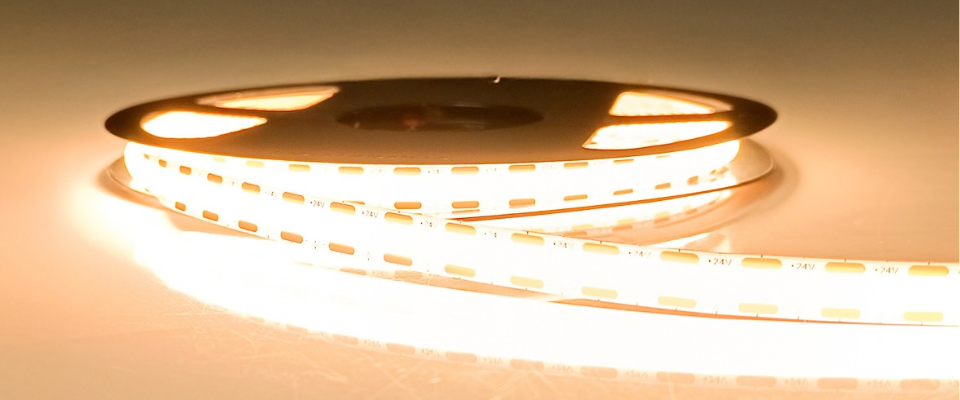
The Mojova Freecut COB strip provides even lighting and can be cut to any length.
The profile and diffuser affect the final result
The aluminum profile gives the installation a neat appearance and helps dissipate heat from the LED strip. The depth of the profile, in turn, affects how much the light has room to mix before reaching the diffuser.
An opal, or “frosted glass,” diffuser softens the light and helps blur the LED dots on an SMD strip. However, even this does not guarantee an even light line if the LEDs are spaced far apart and the profile is very low. With COB strips, the lack of visible dots is inherent to the strip’s structure, but the profile and diffuser can still be used to refine the installation and shape the light.
Would moving lights or color effects work well for this venue?
In digital LED strips, each LED or group of LEDs forms its own pixel, which can be controlled individually. This allows them to create dynamic lighting effects, animations, and color gradients. For example, you can create a static color scheme and display different colors at different points along the strip, or create moving patterns, color transitions, and light animations. The strip is controlled pixel by pixel using a separate SPI-compatible controller.
KVS offers a wide variety of digital LED strips. The versatile Mojova 1-CUT RGBW, suitable for many applications, features individual LEDs that each form their own pixel. With a pixel pitch and cutting interval of only about 17 mm, it can be used to create extremely precise multicolor lighting effects.
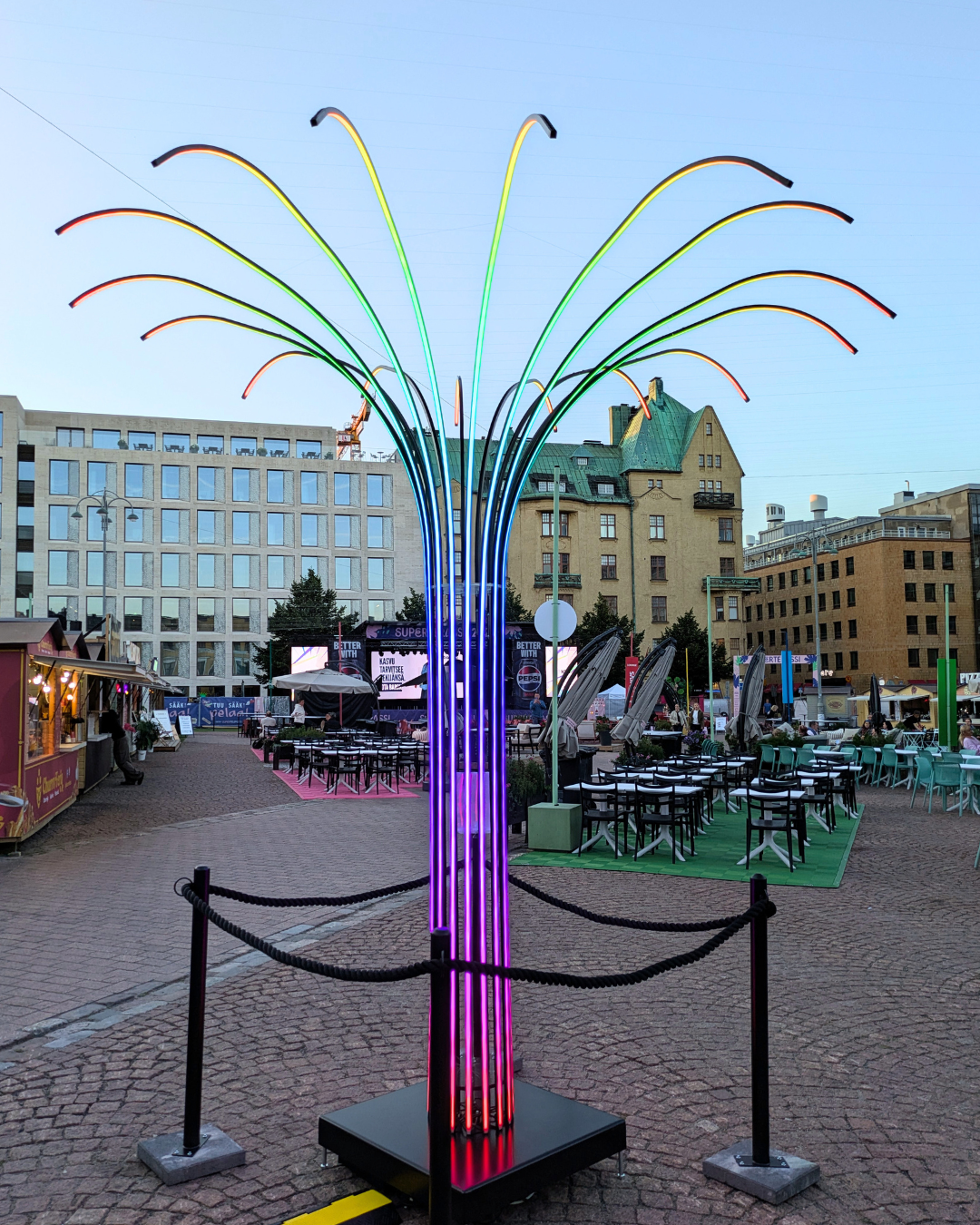
The "Superpuu" light art installation, designed by Jukka Aspin of KVS, used a multicolor (RGB) digital COB LED strip.
Would you like a particularly slender or curved light line?
The new Mojova silicone LED strips are pre-encapsulated in flexible silicone. They can be used to create continuous lines of light even on curved and contoured surfaces. In addition, the silicone LED strips are IP67-rated.
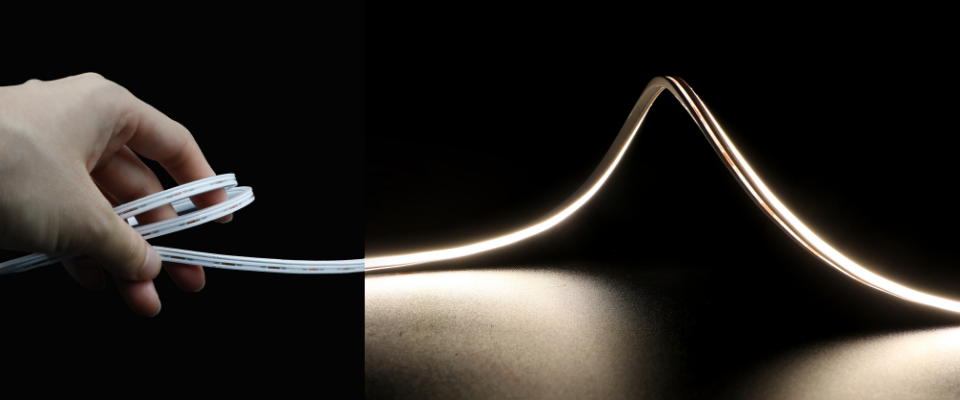
The light-emitting side of the ultra-compact Mojova SIDE 3 × 5 mm is only three millimeters wide, making it easy to install even in narrow structures.
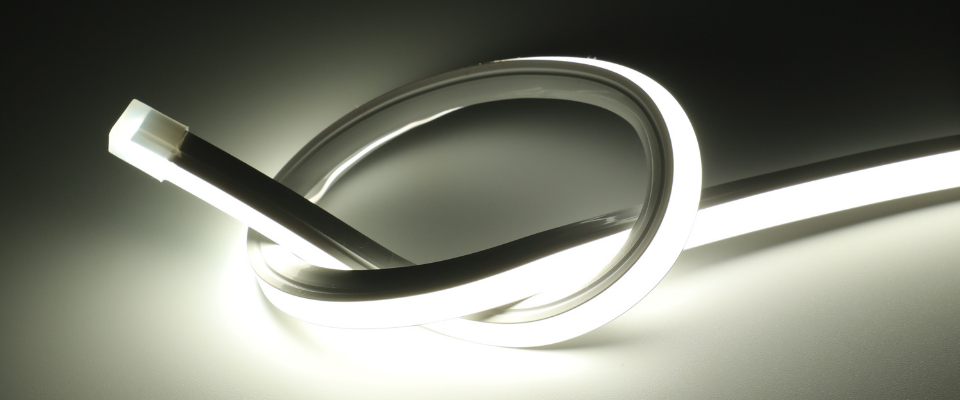
The Mojova FREECUT 3D can be bent in any direction, making it easy to create three-dimensional light installations.
Why are the names of KVS's LED strips so long and full of numbers?
We want to convey as much information as possible about the features of an LED strip right in the headline, so that customers can compare products without having to open the product page. For example, the name of the product MOJOVA COB LED STRIP FREECUT 24V 15W 3000K IP20 5M includes all the most important specifications:
LED Technology: COB
Cutting interval: Freecut; can be cut at any point
Operating voltage: 24 V
Power: 15 W
Color temperature: 3000K
Protection Class: IP20
Roll length: 5 m
As a general rule, all KVS Mojova LED strips follow this same naming convention.
Tell us the length of the light strip, the installation location, and the desired lighting effect. We’ll help you choose the right LED strip, profile, diffuser, power supply, and control system.
The best way to contact KVS is at myynti@kvsoy.fi
You can find other contact information here